The discipline of Payment Economics

U.S. enterprises leave $289 billion in Payment Yield uncaptured every year.

Payment Yield measures the economic return every payment decision produces, expressed in basis points of addressable spend. The return currently scatters across three reports owned by AP, Treasury, and Procurement, which leaves the aggregate outside any standing finance review. Payment Economics is the discipline that aggregates the components, defines the metric, and places ownership of the outcome in the Office of the CFO.

PY = CR × SA
Payment Yield = Capital Return × Supplier Acceptance
The Framework

Your payment operations produce economic return every quarter. The reporting structure scatters the return across three functions and keeps the aggregate outside the quarterly review.

The yield arrives through three channels. Your AP team captures rebate revenue on virtual card volume. Your procurement team negotiates early payment discounts with strategic suppliers. Your treasurer retains float by timing payments against the company's cost of capital. Each channel produces measurable yield. The yield posts to three separate reports under three separate categorizations, which leaves the aggregate outside the standing quarterly review finance leadership uses to evaluate the business.

Payment Yield aggregates the three components into a single metric. The formula reads Payment Yield equals Capital Return times Supplier Acceptance. Capital Return measures the blended rate of return your payment structure produces across virtual card, early discount, dynamic discounting, and float, expressed as a percentage of addressable spend. Supplier Acceptance measures the share of addressable spend that captures those rates. The product expresses yield in basis points, which translates directly into dollars finance leadership can present in a quarterly review.

Yield flows through four tiers. Tier 1 covers direct return from payment method selection, which most AP functions already touch through virtual card and early payment discount programs. Tier 2 covers the capital layer that activates through supply chain finance, embedded lending at the point of payment, and receivables financing triggered by payment data. Tier 3 covers the structural position the treasurer manages through payment hubs, netting arrangements, and cross-border optimization. Tier 4 covers the network effects the discipline generates as benchmark data accumulates across peer organizations.

The practitioner who owns the aggregate is the Payment Portfolio Manager. The credential that certifies the role runs through the Payment Economics Institute.

Explore the Framework
Engagement Models

Three engagements for measuring Payment Yield and closing the gap to benchmark.

Yield Partnership

Advisory compensation tied directly to the incremental Payment Yield your organization captures against a measured baseline. Advisory fees draw from a share of the yield the engagement produces, which aligns advisory economics with the outcome.

Book a conversation

Advisory Retainer

Ongoing Payment Yield advisory with monthly working sessions, asynchronous access between sessions, and quarterly PEI tracking against baseline. Three-month minimum engagement.

See details

Payment Economics Diagnostic

Complete Payment Yield measurement, gap analysis against benchmark, and twelve-month improvement roadmap, delivered as a fixed-fee engagement over thirty to forty-five days.

Learn more
The Discipline

Built on a body of published work.

The Journal

First principles to full portfolio management. Published every week.

Read the Journal

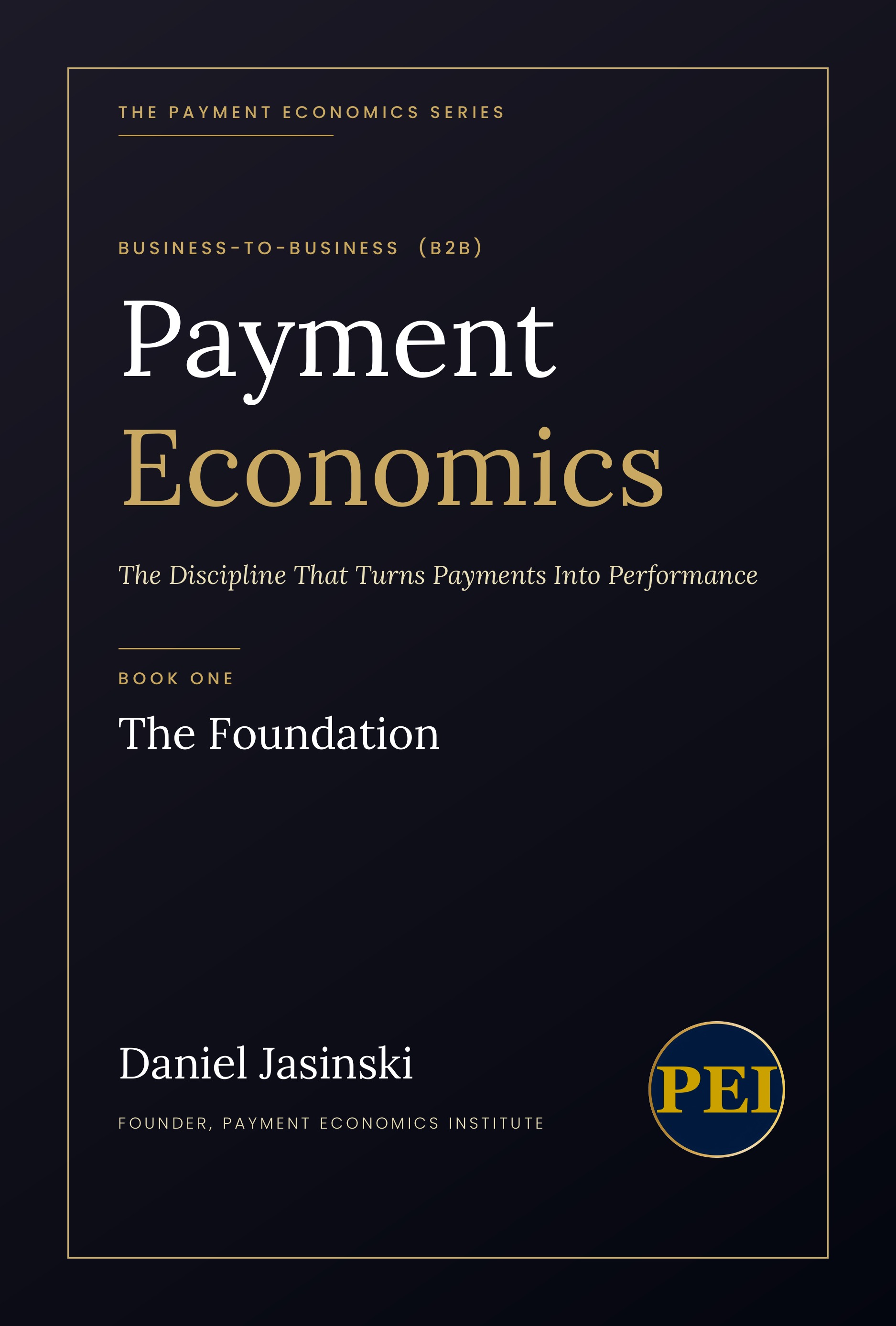
The Book

The complete framework in one volume. The $289 billion gap, the Payment Yield model, and what it takes to own it.

Get the Book

The Certification

Verifiable credential for finance and payments professionals. Six modules, proctored exam, practitioner-level fluency.

Begin Certification
The Payment Economist
Daniel Jasinski

Daniel Jasinski

Daniel observed the same structural gap across twelve years and five B2B payments companies: the economic return of payment decisions had no owner, no framework, and no measurement standard. Payment Economics is the discipline he defined to fill it.

Founder of Payment Economics Institute. Twelve years across five B2B payments companies. Speaker on working capital analytics at Nike World Headquarters.

Full bio
Payment Yield Benchmarks by Industry Report
Special Research Report · March 2026

Payment Yield Benchmarks
by Industry

B2B payment operations have no published performance benchmark. This report changes that: nine industry verticals, four performance tiers, and a dollar-gap analysis at $400M addressable spend, derived from five independent sources.

Free download.

Download the Report
Payment Economics in Practice

The Payment Economics Institute measures Payment Yield across the B2B payments ecosystem: buyers capturing return from payment operations, suppliers evaluating the economics of payment method acceptance, capital providers identifying where working capital creates value, and technology platforms demonstrating measurable yield for their customers. AP Copilot is the first technology provider to demonstrate Payment Economics at scale, achieving 50% Supplier Acceptance across its customer base. The Institute provides introductions for organizations ready to connect with participants who meet the standard.

Request an Introduction